The federal minimum wage of $7.25 has not been raised since July 24, 2009.
Adjusted for inflation, its value has fallen by more than 31% since then, making it the lowest it has been, in real terms, since 1956.1 If the minimum wage had been adjusted to track for increases in productivity since 1968, it would be over $25 an hour today.2
No raise in seventeen years is the longest stretch in American history – leaving full-time workers in poverty.
One effort, Senator Bernie Sanders’ and Rep. Bobby Scott’s Raise the Wage Act, is cosponsored by more than a third of the Senate and the House, would raise the federal minimum wage to $17 an hour over the next five years. Additionally, it would phase out anti-worker policies like the tipped subminimum wage of $2.13, the youth sub-minimum wage, and the sub-minimum wage for workers with disabilities.
The nonpartisan Economic Policy Institute estimates this bill would deliver a raise to more than 22 million workers by 2030.3
And there are other pieces of legislation to raise the minimum wage, including The Living Wage For All Act,4 The Original Living American Wage Act,5 and The Higher Wages for American Workers Act.6
But the corporations that want to keep wages low know that the public is demanding reform. That is why the National Restaurant Association, the lobbying group that represents McDonald’s, Applebee’s, and the rest of the fast-food industry, has spent over $50 million total federal lobbying since the last successful vote to raise the minimum wage.7 8
The good news is that this fight is being won in state after state, often in places the political elite tell us it is impossible.9
When the American people get a chance to vote on this directly, they vote to raise wages. Red states, blue states, and purple states, every time. When given the choice, Americans do not want their neighbors to work full-time and still live in poverty.
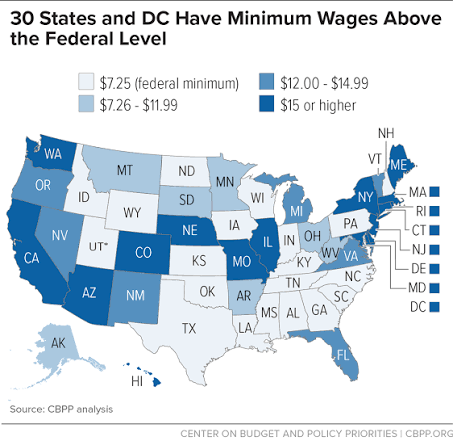
In 2024, voters in Alaska passed Ballot Measure 1, raising the minimum wage to $15 an hour by 2027 and guaranteeing paid sick leave. Roughly 30,000 Alaska workers will get a raise because of that vote.
Also in 2024, voters in Missouri passed Proposition A to raise the minimum wage to $15 and require earned paid sick leave. Estimates say this will raise wages for more than 560,000 Missouri workers and provide paid sick leave to nearly 730,000. When the Republican controlled legislature tried to overturn the will of the voters, the Missouri Supreme Court stepped in and upheld the law.
In 2022, voters in Nebraska raised their minimum wage to $15. In 2020, voters in Florida did the same.
All in, thirty states, represented by 60 Senators, have now raised their own minimum wages above the federal floor.10
And the economic evidence clearly demonstrates that raising the minimum wage is good for workers AND it is good for local businesses and local economies.
When a low-wage worker gets a raise, they do not put the money in an offshore bank account. They spend it. They buy groceries. They fill the car with gas. They take their kid to the dentist. They pay the rent. And they spend it locally, at the diner on the corner, their neighborhood barber shop, the family-owned hardware store.
Economists call this the local multiplier effect and the research is clear: when working people get paid more, those dollars recirculate through the local economy two, three, four times over. Every raise is somebody else’s new customer. Every dollar paid to a worker is a dollar that flows through a community and lifts up the small businesses that anchor it.11
When we raise the minimum wage, we do more than just lift workers out of poverty. We build stronger local economies. We help small businesses. We grow the middle class. The whole community rises.
So this is not a question of whether we can afford to raise the minimum wage. The country is more productive than it has ever been. The question is whether we have the political courage to insist that the people who do the work share in the wealth they create.
The truth is that Congress will not raise the minimum wage on its own. The lobbying is too powerful. The billionaires and corporate campaign contributions are too large.
But by coming together, collectively raising our voices and asserting our civic power, we can accomplish anything. That is why we are asking you to send a letter to your members of Congress today.
This is our fight. It is the fight for a country where work is respected, where a job lifts you out of poverty rather than keeping you in it, and where the wealthiest nation in the history of the world pays its workers enough to live with dignity.
In solidarity,
The Sanders Institute
1 https://cepr.net/publications/the-federal-minimum-wage-hits-a-seven-decade-low/
2 https://cepr.net/publications/raise-the-7-25-federal-minimum-wage/
3 https://www.epi.org/publication/rtwa-2025-impact-fact-sheet/
5 https://www.congress.gov/bill/119th-congress/house-bill/122
10 https://www.cbpp.org/research/economy/the-minimum-wage
11 https://amiba.net/local-multiplier/